Advertisement
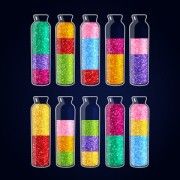
Prepare to embark on a sophisticated journey of chromatic restoration in Get Color - Water Sort Puzzle, a premier intellectual challenge that transforms the laws of liquid physics into a high-stakes arena of logic and strategy. This is not merely a game of sorting; it is a vivid exploration of entropy and order, where players are cast as the ultimate architects of a fractured spectrum. Imagine a laboratory of the mind where a kaleidoscope of brilliant pigments has become inextricably tangled within an array of sleek glass carafes. Your mission is to disentangle this liquid web, applying rigorous deductive reasoning to isolate every shade into its own pristine vessel. It is a sleek, minimalist environment where the soothing sounds of pouring water mask a complex underlying architecture of spatial puzzles that will test even the most disciplined thinkers.
The core essence of the experience is built upon a deceptively simple foundation: you must transfer colored water between tubes until each container holds a single, uniform color. However, the path to order is governed by a strict rule of compatibility—you can only pour a liquid onto another if the colors match at the point of contact and if there is sufficient volume remaining in the target vessel. To get started, a novice should focus on the "surface scan" technique, identifying immediate matches that can be consolidated to clear up headspace. The beauty of the initial phase is its accessibility; within seconds, anyone can grasp the tactile satisfaction of a successful pour, making it an instantly engaging pursuit for those seeking a quick mental tune-up or a deep, meditative flow state.
To transcend basic play and achieve the status of a master strategist, one must adopt a philosophy of "void management." The most critical tactical maneuver for rapid progression is the swift creation of an empty tube. An unoccupied vessel is your most versatile tool, acting as a strategic waypoint that allows for the temporary storage of inconvenient layers. Instead of reacting to the colors on top, expert players look for "bottleneck" layers—those thin slivers of color that sit atop a different, larger mass. By prioritizing the removal of these obstacles, you unlock the board's potential and prevent the structural gridlock that often stalls slower players. Speed is not about moving your hands faster, but about reducing the total number of transfers required to reach the solution.
Another professional-grade technique for clearing levels with lightning efficiency is "Foundation Mapping." Before making your first move, examine the base of each tube. Identifying which color occupies the bottom of most vessels allows you to designate "home" tubes early in the process. By committing to a specific color for a specific tube based on its existing foundation, you eliminate the redundant shuffling of liquids back and forth across the board. Furthermore, always look for the most "buried" color—the one trapped under the most diverse layers—and work systematically to excavate it. This proactive approach ensures that you are never left with a single, unreachable droplet at the end of a round, allowing you to breeze through hundreds of stages with a rhythmic, unbroken cadence.
As the final stream of vibrant liquid settles and the last tube achieves its monochromatic perfection, you are rewarded with a profound sense of cognitive alignment. Get Color is more than a puzzle; it is a ritual of mental clarity that sharpens your foresight and rewards your patience with visual brilliance. It challenges you to see through the chaos of a mixed palette to find the hidden harmony beneath. By mastering the delicate balance of volume and hue, you transform a jumbled array of glass into a masterpiece of organization. Step into this world of fluid logic, sharpen your strategic intuition, and discover the immense satisfaction that comes when every drop finally finds its rightful place in the grand design of the spectrum.
Advertisement