Advertisement
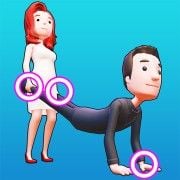
In a bustling, minimalist digital realm where everyone seems to have forgotten the fundamental mechanics of walking, sitting, or even existing in a straight line, you have been called upon as the ultimate, chaotic choreographer in Move People. The setting is a stark, color-coded sandbox filled with awkward, flailing ragdolls who are constantly getting themselves tangled in impossibly difficult situations. The premise isn't about saving the world; it’s about saving these hapless individuals from themselves by dragging, pulling, and posing them into perfectly functional positions. Whether it’s placing a man gently onto a sofa, helping a couple embrace without knocking over a lamp, or organizing a group of people into a stable pile, the environment is a high-stakes playground of physics-based hilarity. The atmosphere is frantic and utterly comedic, challenging you to overcome the erratic inertia and stubborn limb resistance of characters who seem designed to defy all logic and comfort.
The gameplay mechanics are deceptively simple, focusing entirely on a click-and-drag system that turns limb manipulation into an art form—or more likely, a hilarious disaster. You control the ragdolls by clicking on specific joints—elbows, knees, hips, or shoulders—and pulling them toward the target pose highlighted on the screen. The challenge lies in the unforgiving physics engine; pulling a character's leg too quickly will send them tumbling across the room, while trying to twist their torso might cause them to break into a chaotic spin. Success requires a delicate touch and a keen understanding of weight and leverage, as you must maneuver the figures around furniture, walls, and each other without causing a catastrophic chain reaction of falling bodies and broken items.
Getting started in this world of ergonomic anarchy is easy if you focus on small, calculated movements rather than grand gestures. A vital tip for rapid success is to always move the character's core first; drag their hips or torso to the general vicinity of the target position before attempting to adjust their arms or legs. For beginners, it’s best to treat the ragdolls like heavy, uncooperative puppets rather than liquid beings. Instead of rushing to match the target pose perfectly, take it step by step: get them seated first, then work on positioning the arms, and finally, tweak the head angle. This methodical approach minimizes the chaotic flailing that often leads to failure, allowing you to gradually impose order on the mess.
To truly breeze through the more complex levels and achieve flawlessly executed poses, you must learn to use the environment to your advantage. If a character keeps sliding off a chair, push them against a wall to stabilize them while you adjust their limbs. In scenarios with multiple people, tackle them one at a time, anchoring one character in their required pose before moving on to the next. The most efficient strategy for tricky puzzles is to observe the desired final posture carefully and identify which joint needs to be moved first to avoid limb collisions. Furthermore, don't be afraid to pull limbs through obstacles if necessary; the game’s physics often allow for this, turning frustrating obstructions into convenient tools for positioning. Ultimately, patience is your best ally, as frantic clicking usually results in a more chaotic scene.
As you place the final limb into its required spot, watching your previously tangled pile of people suddenly form a perfect, harmonious tableau, the satisfaction is immense. Move People transforms the mundane act of sitting or standing into a hilarious, high-stakes puzzle, rewarding creative thinking and a steady hand. It is a game that celebrates the absurdities of human movement and the joy of imposing order on absolute chaos. So, brace yourself for the hilarious flailing, prepare to rearrange the awkward, and immerse yourself in a world where you are the master of spatial manipulation, turning every chaotic encounter into a moment of perfectly posed triumph.
Advertisement